Why the SEO Analysis Keynote Template Transforms Data into Decisions
You have spent hours digging through analytics, keyword rankings, and backlink profiles. The insights are clear in your mind, but the moment you open a blank presentation, that clarity vanishes. Building slides from scratch drains time you could spend on strategy. An SEO Analysis Keynote Template changes that dynamic by giving you a structured, professional foundation that elevates your data without demanding design skills. Instead of wrestling with layouts, you focus on the story behind the numbers. This matters whether you are pitching a retainer to a client, reporting quarterly progress to executives, or teaching a workshop on search visibility. The right template becomes a reliable communication partner, not just a set of slides.
Professionals often underestimate how much visual polish affects credibility. A messy slide deck with inconsistent fonts and clashing colors can undermine even the most thorough analysis. A purpose-built SEO Analysis Keynote Template eliminates that risk. With master slides that control design consistently across the board, every element stays aligned, and the 16:9 Full HD resolution ensures your work projects cleanly on any modern screen. Animated transitions between sections—when used subtly—guide attention naturally, helping audiences follow complex topics like crawl budgets or content decay patterns without feeling lost. The result is a presentation that feels cohesive and considered, reinforcing your expertise.
Clarity Through Structured Infographics and Customizable Visuals
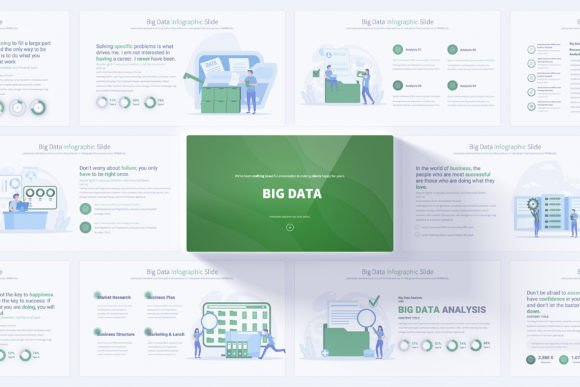
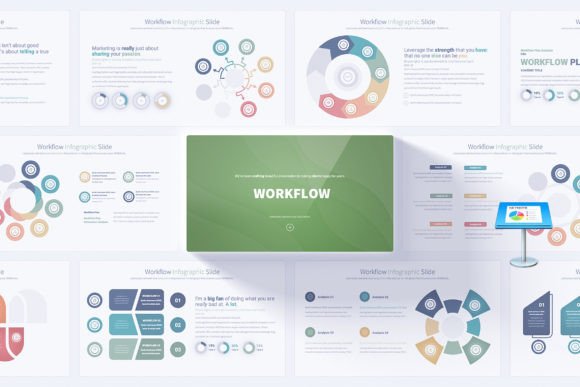
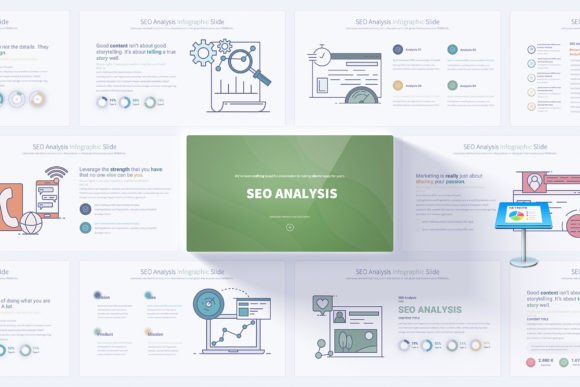
Raw spreadsheets rarely inspire action. The human brain processes visual patterns far faster than columns of numbers. This is where handmade infographics built into the template provide immediate value. Instead of drawing your own charts for domain authority comparisons, organic traffic trends, or keyword gap analyses, you can adapt existing visuals. Each infographic is designed with SEO conversations in mind: think flow diagrams for site architecture, layered donut charts for traffic sources, and bar comparisons for competitive benchmarks. Because the vector icons and elements are fully editable, you can resize, recolor, or swap components without quality loss. That means a single slide can shift from showcasing a local SEO audit to explaining an e-commerce category structure in minutes, simply by changing a few icons and data points.
Customization goes beyond surface colors. The template offers 12 distinct color variations on a light background, so you can quickly tailor the mood to match a brand palette or a conference theme. This is helpful for agencies serving multiple clients with different visual identities. Instead of maintaining separate slide decks for each account, you have one robust source file that adapts. The SEO Analysis Keynote Template also includes 204 total slides derived from 17 unique layouts, giving you impressive depth without feeling repetitive. You might use one layout for a technical audit summary, another for content performance timelines, and yet another for backlink acquisition progress. This variety prevents audience fatigue and lets you emphasize different data types appropriately.
From Quick Internal Updates to Boardroom Pitches
Not every SEO presentation needs the same level of detail. A weekly stand-up with a marketing team might require only a handful of slides showing key metric shifts, while a quarterly board presentation demands a polished narrative with opening and closing slides that bookend the message. The professional opening and closing slides included in the template are crafted to introduce the topic and leave a lasting impression. You can adapt them for project kickoffs, strategy proposals, or results summaries. A freelance SEO consultant, for example, can use the opening slide to state their methodology and the closing slide to summarize recommended next steps and projected timelines. This structure saves mental energy because you are not inventing a flow from scratch every time.
For digital marketing managers inside organizations, the ability to generate consistent reports builds trust over time. When your stakeholders recognize a familiar format, they process information faster, leading to more productive discussions. They know where to look for the overall health score, the competitors benchmark, and the action items. The SEO Analysis Keynote Template helps you establish that rhythm by providing a framework that is flexible but coherent. You can highlight issues like core web vitals deviations or cannibalization problems using icons that clearly signal warnings or opportunities. The included bonus of 280 editable vector icons means you are rarely stuck hunting for a visual metaphor that feels accurate.
Saving Hours Without Sacrificing Originality
Time saved on slide design is time gained for analysis and interpretation. Consider a typical scenario: you have just completed a site audit and identified 25 technical issues. Turning those findings into a meaningful presentation manually could take half a day as you align text boxes, choose fonts, and format tables. With this template, you simply populate the relevant data into pre-built structures. The infographic for a site health checklist, for instance, might already have a color-coded status indicator. You adjust the percentages and labels, and the visual updates instantly. Because the elements are based on master slides, you can apply global changes—like swapping the accent color from teal to terracotta—across the entire presentation in seconds. This ensures your deck always looks intentional, not thrown together.
Efficiency also comes from the PDF documentation included. Instead of guessing how a particular slide works or where editable zones are, you can reference the guide. This lowers the learning curve for those less familiar with Keynote. A small business owner who handles their own SEO but only creates presentations occasionally will appreciate being able to start from a solid baseline rather than facing an intimidating blank canvas. The user-friendly structure means you spend less time on formatting and more time practicing your delivery or refining your data narrative.
When This Template Fits Your Workflow—and When to Look Elsewhere
Of course, no single resource suits every situation perfectly. The SEO Analysis Keynote Template is designed for Keynote specifically, not PowerPoint or Google Slides. If your organization runs entirely on Microsoft Office or web-based tools, you will need to consider whether you are comfortable converting files or working exclusively in Keynote. Some users might find the 17 unique slide layouts more than enough, while others with very niche data visualization needs—like highly interactive dashboards or live-updating charts—might still need supplementary tools. The template provides static but beautifully designed infographics; it does not pull live data from APIs. That is a reasonable trade-off for most presentation purposes, because live data often introduces complexity that distracts from the core message. Still, if your audiences expect real-time dashboards inside a slide deck, this might not be the only resource you require.
Another consideration is design taste. The 12 color variations on a light background are professional and clean, but if your brand relies on dark-themed presentations with intense high-contrast visuals, you may need to manually tweak backgrounds. The template’s vector icons and infographics are fully editable, so you can adapt, but it adds a step. In most corporate and agency settings, however, a light background with clear contrast is the standard because it projects well in well-lit rooms and prints legibly when needed. The 16:9 aspect ratio also matches virtually all modern displays, which is a practical benefit.
Who Gains the Most from an SEO-Focused Keynote Toolkit
SEO specialists who regularly present to non-technical stakeholders find the greatest value here. You can translate complex concepts like domain rating, topical authority, and indexation status into intuitive visuals. A marketing vice president may not care about the exact percentage of nofollow links, but they do care about the impact on organic reach. The infographics let you bridge that gap by showing before-and-after comparisons and projected growth corridors. This not only improves understanding but also speeds up approvals for resources. When decision-makers see a clear path from effort to result, they are more likely to back your initiatives.
Educators and workshop leaders also benefit. Teaching SEO involves many moving parts: keyword research, on-page optimization, link building, and performance tracking. Jumping between unrelated slide designs confuses learners. A cohesive template keeps the focus on the material. You can teach a full module on competitive analysis using slides that already contain placeholder data for market share graphs, SERP feature trackers, and content gap matrices. The fact that you have 204 slides to choose from means you can design an entire course without repeating a layout too often. The 280 vector icons let you build custom exercises or quick reference sheets that maintain the same visual language.
Bloggers and content creators who monetize through affiliate marketing, courses, or consulting can also use the template to present performance data to brand partners. A polished media kit or a case study slide deck that shows organic traffic growth, audience demographics, and conversion patterns builds greater confidence than a hastily assembled document. The handmade infographics feel authentic and considered, which aligns with the personal brand many creators cultivate.
Practical Tips for Getting Started
Before you start populating slides, sketch the narrative arc of your SEO analysis. Identify the core question you are answering: Is it “Why did organic traffic drop last quarter?” or “What are the top three opportunities for the next campaign?”? Once you know the story, you can pick slides from the template that serve each segment of your argument. For example, start with a problem overview using a custom infographic, layer in supporting data with the comparison layouts, and conclude with a clear recommendation on a closing slide. Avoid the temptation to use every slide just because they are available; restraint often communicates confidence better than volume.
Color coding can significantly improve readability. Use one of the 12 color variations as your primary skin and then incorporate the bonus vector icons strategically. If you are auditing multiple websites, assign a consistent icon to each site across all slides. This visual cue helps the audience follow along even when you switch between different charts. Because the icons are fully editable, you can even nestle them into flowcharts or timeline slides to create a completely original diagram that still fits the template’s design language.
Remember that animated transitions should serve a purpose. In an SEO analysis presentation, a subtle reveal can build anticipation before you unveil a critical finding—like a drop in core keyword rankings. But overusing motion can distract. The template includes animations that are tasteful and professional; you can adjust their timing or disable them altogether depending on the setting. A business strategy meeting may call for straightforward slide advancement, while a conference talk might benefit from smoother scene changes.
Finally, store your customized template as a reusable file. Once you have adjusted the master slides to match your brand fonts and preferred colors, save it as a base version. The next time you need an SEO Analysis Keynote Template for a new project, you can start from that tailored foundation rather than the original. This compounds the time-saving benefit and keeps your external messaging consistent. For agencies, this approach ensures all client presentations share a signature look while allowing per-client customization through color variations and icon swaps.
Making SEO Data Speak Human
The real power behind this template is not in the slide count or the color palettes; it is in how it forces you to translate raw data into human stories. SEO is rarely about one metric. It is about connecting search intent with user experience, technical health with content quality, and backlink profiles with brand credibility. A well-structured visual can show those relationships in an instant, turning a room full of skeptics into collaborators. By reducing the friction between analysis and presentation, the SEO Analysis Keynote Template helps you spend more time in the strategic space and less in the design weeds.
Whether you are a freelancer looking to impress your next prospect, a marketing director preparing a yearly review, or an educator building a reputable curriculum, having a reliable, adaptable, and professional slide system matters more than ever. In a world where attention spans are short and competition for buy-in is fierce, clear communication becomes a competitive advantage. The template does not do the thinking for you, but it gives you the tools to make sure your thinking is seen, understood, and acted upon.