Heaven Solid Icon Design: Principles, Applications, and Cross-Platform Versatility
Understanding the Visual Language of Solid Icons
Solid icons represent one of the most enduring and adaptable elements in visual communication design. Unlike outlined or line-based alternatives, a Heaven Solid Icon communicates with clarity and presence, filling its silhouette entirely to create an unmistakable visual anchor on any surface or screen. The solid approach removes ambiguity, allowing viewers to process meaning almost instantaneously. This makes the style particularly effective for interfaces where quick recognition matters, such as navigation menus, dashboard controls, and mobile app toolbars.
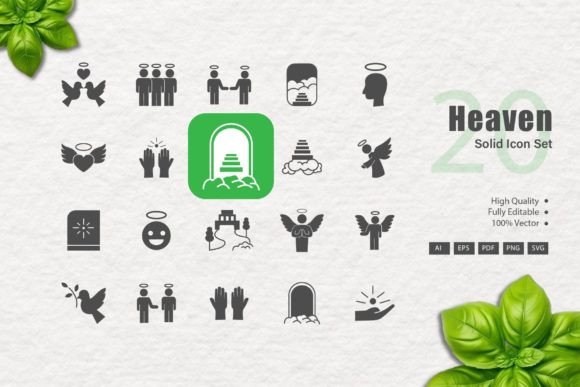
What distinguishes premium solid iconography from generic alternatives lies in the precision of its geometry. Every curve, corner radius, and proportional relationship must harmonize across an entire set. When a designer picks up a Set of 20 Solid Heaven Icons, they encounter a collection where each symbol feels like part of a unified family. The stroke weights, fill densities, and optical adjustments have been calibrated so that a cloud icon sits comfortably beside a halo symbol, and neither overpowers the other. This internal consistency separates professional-grade assets from amateur efforts.
The Aesthetic Appeal of Minimalist Heavenly Motifs
Heavenly themes carry universal cultural resonance. Clouds, halos, wings, light rays, and celestial bodies evoke feelings of serenity, transcendence, and aspiration. When rendered in a simple and clean design, these motifs transcend specific religious or spiritual contexts and become versatile visual metaphors. A solid cloud icon might represent cloud computing on a tech dashboard, dream states in a meditation app, or weather conditions on an infographic. The flexibility inherent in well-designed heavenly iconography explains its enduring popularity across disparate industries.
Minimalism amplifies this versatility. By stripping away unnecessary detail, a Heaven Solid Icon achieves what ornate illustrations cannot: it scales effortlessly from a tiny mobile favicon to a large-format poster print without losing legibility. The solid fill ensures consistent visibility against both light and dark backgrounds, though smart designers often test contrast ratios to guarantee accessibility compliance. This scalability and adaptability make solid heavenly icons a practical investment for anyone building a visual asset library.
Website and Mobile App Integration
Digital interfaces demand iconography that loads quickly, renders crisply at multiple resolutions, and communicates function without relying on accompanying text. The SVG file format included in a comprehensive icon set excels here. SVG icons are resolution-independent, meaning the same file looks razor-sharp on a standard definition screen and a high-density retina display. Developers can also manipulate SVG code directly to animate icons, change colors on hover states, or integrate them into dynamic theming systems.
Mobile app designers benefit from PNG files with transparent backgrounds sized at 3000 x 3000 pixels. This generous native resolution allows for extreme flexibility during asset preparation. An icon can be exported at 48x48 pixels for a tab bar, 512x512 pixels for an app store listing, or any custom dimension in between without introducing artifacting or blur. The transparency ensures seamless placement over gradient backgrounds, photographic imagery, or textured surfaces without an unsightly bounding box.
Print Media: Books, Flyers, and Posters
Print design imposes demands that screen-based projects do not. Color separations, ink saturation, and physical scaling require icon files built with vector precision. The Adobe Illustrator AI file and companion EPS file formats serve as the definitive sources for print work. These formats preserve every anchor point, bezier curve, and fill property as mathematical instructions rather than fixed pixels. A designer laying out a spiritual retreat flyer can scale a Heaven Solid Icon to fill an entire A3 poster without encountering jagged edges or compression artifacts.
Books represent a unique challenge because iconography often appears small, inline with text, or in marginal callouts. Solid icons outperform outlined styles here because their filled shapes maintain visual presence even at 6 or 8-point sizes. A publishing house producing an inspirational volume might sprinkle heavenly solid icons throughout chapter headings, creating a cohesive visual rhythm that enhances the reading experience without overwhelming the textual content.
Social Media and Infographic Design
Social media content competes for attention in crowded feeds. Solid icons provide bold, scannable visual punctuation that stops a scrolling thumb. A carousel post explaining wellness concepts might use a Heaven Solid Icon at each slide's corner to establish brand identity and guide viewers through sequential information. The flat design style of these icons harmonizes with contemporary social media aesthetics, which favor clean lines and uncluttered compositions over skeuomorphic detail.
Infographics present a natural home for solid icon sets. Data visualization relies on symbols to represent categories, highlight statistics, and direct the eye through information hierarchies. A designer crafting an infographic about global belief systems or atmospheric science could deploy heavenly solid icons as consistent visual shorthand. Because the icons arrive in fully editable vector formats, the designer can recolor them to match a brand palette, resize individual elements within a composition, or combine multiple icons to create novel composite symbols.
Working with Vector Source Files
The true power of a professional icon set emerges during customization. Opening an AI or EPS file in Adobe Illustrator grants access to every constituent path. A designer dissatisfied with the default blue of a cloud icon can select the shape and apply any hex code, gradient, or pattern fill imaginable. This editability extends beyond simple color changes. Individual anchor points can be nudged, path curves adjusted, and proportions tweaked to align with specific layout requirements. The non-destructive nature of vector editing encourages experimentation without fear of degrading the source material.
For teams working across different software ecosystems, the SVG and PDF formats provide broad compatibility. SVG files open natively in browser-based design tools, Figma, Sketch, and Affinity Designer. PDF files preserve vector data and can be placed directly into InDesign layouts or opened in CorelDRAW for further manipulation. This format diversity ensures that a Heaven Solid Icon set integrates into virtually any professional workflow, regardless of preferred software stack.
Color Adaptation Strategies
Solid icons respond dramatically to color transformations. A single Heaven Solid Icon rendered in luminous gold conveys warmth and divinity, while the same icon in cool slate gray projects corporate restraint. Designers working on multi-brand projects appreciate this chromatic flexibility. The flat design approach means there are no complex gradients or shading layers to untangle before making adjustments. Select, recolor, export. The streamlined process saves hours when adapting assets for seasonal campaigns, client rebranding, or A/B testing different visual treatments.
Accessibility considerations should guide color choices. A solid white icon on a pale pastel background may fail contrast ratio standards, rendering it invisible to users with visual impairments. Testing tools can validate whether foreground and background combinations meet WCAG guidelines. The high native resolution of the 3000 x 3000 pixel PNG files allows designers to export versions with slight drop shadows or subtle outlines if pure solid contrast proves insufficient for a particular implementation.
For Educators and Researchers
Academic presentations and research posters benefit from clear, distraction-free visual aids. A lecturer explaining theological concepts or atmospheric phenomena can incorporate Heaven Solid Icon elements into slide decks without worrying about culturally specific artistic interpretations. The neutrality of flat solid design allows the icon to support the content rather than compete with it. Researchers publishing in academic journals appreciate the PDF vector format because it meets the resolution requirements of scientific publishers while remaining editable for future iterations of the work.
For Business Owners and Entrepreneurs
Brand consistency across customer touchpoints builds trust and recognition. Small business owners without dedicated design teams can use a cohesive icon set to unify their website, printed menus, social media profiles, and physical signage. A wellness center might adopt a particular Heaven Solid Icon as a recurring motif, appearing on business cards, appointment reminder emails, and the storefront window. The simple and clean design aesthetic projects professionalism, suggesting attention to detail and quality without veering into ostentation.
E-commerce sellers benefit from the transparent PNG formats when creating product listings. Icons can float over lifestyle photography, highlight key features, or decorate promotional banners without awkward bounding boxes breaking the visual flow. The generous pixel dimensions provide headroom for high-resolution product zoom features that modern online shoppers increasingly expect.
For Hobbyists and Creative Enthusiasts
Personal projects deserve polish too. Scrapbookers designing custom stickers and prints, community event organizers creating flyers, and DIY crafters producing vinyl decals all benefit from professional-grade icon assets. The availability of vector EPS files means a hobbyist with access to a cutting machine can trace precise paths for physical media. Digital planners and bullet journal enthusiasts can incorporate heavenly solid icons into their layouts, printing them at any scale without quality loss.
Evaluating Cohesion Across a Complete Collection
A Set of 20 Solid Heaven Icons should feel internally consistent whether viewed individually or as a group. Check that line weights remain uniform, corner radii follow the same rules across all symbols, and the overall visual density stays balanced. An icon set where some symbols feel bold and heavy while others appear delicate breaks the illusion of professional craftsmanship. Testing the icons at small sizes reveals whether details collapse into indistinct blobs or remain legible. The best solid icons anticipate these real-world constraints and simplify their geometry accordingly.
Licensing and Usage Rights
Understanding what a purchase entitles you to matters. Commercial projects, client work, and merchandise production may carry different licensing requirements than personal use. Confirming that the included AI, EPS, SVG, PDF, and PNG files come with appropriate usage rights prevents legal complications down the line. The breadth of formats provided often signals that the creator intends the assets for versatile application, but verifying the specifics remains a prudent step before integrating icons into high-visibility projects.
Long-Term Asset Management
Organizing a newly acquired icon set for efficient future retrieval saves cumulative hours. Creating a master folder with subdirectories sorted by file format allows quick access when a specific project demands a particular format. Tagging files with descriptive metadata, such as the icon name and primary color scheme, turns a simple folder into a searchable asset library. Since vector files remain editable indefinitely, a well-organized Heaven Solid Icon collection can serve projects for years without degradation or obsolescence.
Designing with Intent and Purpose
The effectiveness of any icon lies not merely in its aesthetic qualities but in how thoughtfully it is deployed. A Heaven Solid Icon placed without consideration for surrounding whitespace, alignment, or visual hierarchy becomes decorative noise rather than functional communication. Designers who treat icons as integral components of an information architecture rather than afterthought embellishments achieve results that feel cohesive and intentional. Testing compositions with representative users, gathering feedback on recognizability, and iterating based on real-world observation separates competent work from exceptional outcomes.
Color, scale, repetition, and placement all contribute to an icon's communicative power. Using the same Heaven Solid Icon at different sizes across a single layout can establish information hierarchy without requiring additional typographic treatment. Limiting the color palette to two or three carefully chosen hues maintains visual restraint while allowing icons to punctuate key messages. Consistency in these decisions across an entire project or brand ecosystem amplifies professionalism and builds audience familiarity over time.
The availability of 100 vector high-resolution assets in a flat design style opens creative possibilities that extend far beyond the obvious applications. Motion designers can import the AI or SVG files into After Effects for kinetic typography projects. Web developers can inline SVG code for lightweight, customizable interface elements. Printmakers can extract paths for silk screening. Each format serves a distinct purpose, and understanding which to use for a given context maximizes both efficiency and output quality. The compatibility with Adobe Illustrator ensures a smooth starting point, while the diverse export formats guarantee that no project remains out of reach due to software limitations.
Ultimately, solid heavenly icons endure as a design resource because they balance aesthetic appeal with practical utility. They communicate complex ideas through simplified forms, adapt to countless contexts through multiple file formats, and reward thoughtful customization with distinctive results. Whether destined for a mobile screen, a printed page, or a social media feed, a well-crafted Heaven Solid Icon carries its meaning with clarity and grace.