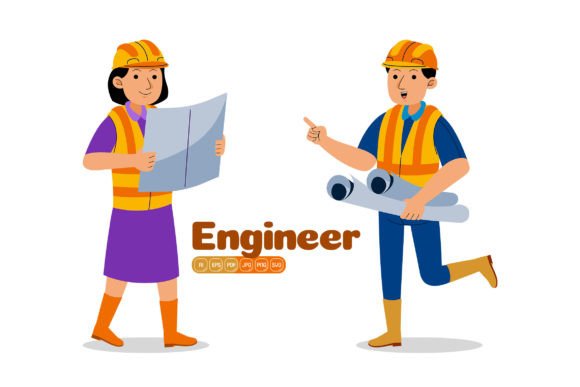
Man and Woman Construction Engineer Vector Illustrations
If you’ve ever needed to add a professional, construction-themed character to your design work, a complete illustration pack saves you hours of drawing time. The Man and Woman Construction Engineer collection gives you 100 high-resolution flat design people ready to drop into websites, social posts, banners, and print materials. Instead of starting from scratch or mixing mismatched clip art, you get a consistent set of male and female engineers in hard hats, holding blueprints, inspecting plans, and working around scaffolding and tools.
These aren’t static, single-pose drawings. The pack includes a wide range of actions, expressions, and construction-related objects that feel natural in professional and casual project visuals. Every element is vector-based, which means you can resize without losing sharpness, tweak colors to match your brand, or pull apart different pieces to build new scenes. If a helmet needs to be orange instead of white, you change it. If your social feed uses a specific blue, you apply that in seconds.
What’s Inside the Construction Illustration Set
You receive 100 distinct characters and objects unified by a clean flat design style. Flat design removes unnecessary shadows and gradients, keeping images crisp on screens and in print. The set focuses on realistic construction environments without becoming too technical. You’ll see engineers holding walkie-talkies, standing beside cranes, reading site plans, and carrying toolboxes. Both men and women are portrayed equally, so your projects feel inclusive and modern.
Each illustration comes as an independent vector file. That means you can open one character, isolate their hard hat, change its color, and save a variant for a different campaign. You can also group several illustrations together to form a busier construction site scene. The consistency of style across all 100 pieces means everything looks like it belongs together, even if you mix a female architect with a male surveyor and a set of safety cones.
For anyone used to hunting for matching icons, this cohesion is a huge time-saver. You won’t suddenly realize one character is semi-realistic while another is cartoonish. The entire pack feels like one well-planned family of graphics.
Where Flat Design Engineer Characters Shine
These illustrations work across so many contexts because the flat design style stays current and approachable. A Man and Woman Construction Engineer graphic can make a blog post about building safety feel more human. It can turn a dry corporate report into a visually engaging PDF. Here are some practical ways people put the collection to use:
- Infographics and statistics: Place an engineer beside data points about infrastructure spending or construction timelines to add personality.
- Social media campaigns: Use the characters in Instagram stories, LinkedIn posts, or Facebook ads for construction companies, training programs, or recruitment drives.
- Website and landing pages: A friendly illustrated engineer can soften a landing page for a project management tool or a civil engineering consultancy.
- Printed flyers and posters: The high resolution lets you scale up to poster size without pixelation, ideal for trade shows or site safety boards.
- E-learning and training materials: Instructors use these figures in slides and handouts when explaining equipment operation, hazard zones, or teamwork on site.
- Custom merchandise or stationery: Because you can change colors and details, you can print simplified versions on hard hat stickers or company notepads.
You’re not limited to one industry. Architects, civil engineering firms, real estate developers, HR departments hiring construction workers, and even educational publishers find reasons to include these visuals. The neutral, professional expressions also make them suitable for corporate annual reports or investor presentations that need a subtle human element.
Customizing Every Shape and Color Like a Pro
A standout feature of this Man and Woman Construction Engineer bundle is how deeply editable it is. Since you get vector formats (AI, EPS, SVG), each shape within an illustration is a separate object. You aren’t stuck with a static JPEG that only lets you crop. In Adobe Illustrator or any compatible vector software, you can click on a vest, a safety helmet, or even the stripe on a pair of boots, and change its fill color instantly.
You could also resize elements independently. Need a larger blueprint roll in someone’s hand? Scale that object without touching the rest of the character. Combine different heads, torsos, and tools from separate files to create an entirely new engineer pose that isn’t in the original pack. Over time, your collection becomes a flexible construction scene builder.
The ability to re-color is especially useful for branding. If your company’s color palette uses a specific shade of yellow-green for safety gear, you adjust the illustrations to match. If you’re designing a series of materials for a client in the energy sector, you can quickly recolor all hard hats to their brand color. This small step makes the assets feel custom-designed rather than off-the-shelf.
Understanding the File Formats and Resolution
You get a well-organized folder with multiple formats so you can jump into any design tool. Here’s what each type offers:
- AI (Adobe Illustrator): The native vector file with full editability intact. Open it, ungroup items, and start shaping.
- EPS: A universal vector format that imports into older Illustrator versions, CorelDRAW, Affinity Designer, and others.
- SVG: Perfect for web use and can be directly embedded into HTML or opened in many free design tools like Inkscape and Canva.
- PDF: Great for sharing with clients or printing from standard document viewers while preserving vector quality.
- JPG: High-resolution raster image (5000 x 5000 pixels) on a white background, ready for quick use.
- PNG: Same high resolution but with a transparent background, so you can place the engineer over any photo, texture, or colored box without a white rectangle behind them.
The 5000 x 5000 pixel dimension means even if you only use the flat raster formats, the image is large enough for most print designs up to roughly 16 inches square at 300 DPI. For digital screens, it’s overkill in the best way — you can scale down with zero quality loss. Whether you’re building a full-width website hero image or a tiny app icon, the source files give you crisp output every time.
Practical Ways to Start Using Your Engineer Graphics
When you first open the pack, it helps to have a small project in mind so you don’t feel overwhelmed by choice. Try creating a quick social media banner: pick one female engineer with a tablet, change her vest to your brand color, and set her on a subtle construction site background. Add a headline like “Building Tomorrow’s Infrastructure” and post it on LinkedIn. The clean graphic will look custom-made.
Another realistic use is redesigning an “About Us” page for a home renovation company. Instead of stock photos that feel impersonal, place a male and female construction engineer side by side with blueprints. That illustration can become a friendly header that sets a knowledgeable, approachable tone. Because the characters are not photos, you avoid the awkwardness of model releases or overused stock images your competitors might have.
For content marketers, these assets speed up the creation of multiple visual pieces. Drop them into blog post featured images, then reuse a different character for an email newsletter header. You can even animate simple movements in After Effects or a web animation tool by separating arms and adding a subtle wave. The vector separability opens up motion design possibilities.
Things to Keep in Mind Before You Dive In
As helpful as a large illustration set can be, there are a few points worth considering to get the most value from your Man and Woman Construction Engineer pack. First, you’ll need a way to edit the vector files. While the PNG and JPG versions are usable everywhere, color changes and element combining require software that handles AI or EPS files. Adobe Illustrator is the gold standard, but free alternatives like Inkscape or browser-based editors like Photopea also work with SVG files.
Second, flat design style, while versatile, might not suit every serious or highly technical report that expects realistic photography. However, for most digital and print content aimed at a general audience, this style performs very well. It keeps the focus on information rather than distracting details. If your project needs gritty realism, you may still use these illustrations as infographic accents or presentation icons rather than main hero images.
Third, because you can create countless variations, spend a bit of time organizing your customized files. Naming conventions like “engineer_female_orange_helmet.svg” will save you from opening dozens of files to find the right one later. A little upfront folder discipline makes the pack a long-term asset.
Finally, remember that merging elements from different illustrations can lead to tiny mismatches if stroke weights or scale aren’t consistent. The pack keeps proportions uniform, but when you start mixing arm from one figure and tool from another, double-check alignment. The good news is that flat design’s simplicity makes such adjustments easy to spot and fix.
Who Benefits Most from a Construction Character Set
Freelance designers who serve multiple construction-related clients will find the pack instantly profitable. Educators building visual aids for safety training can produce professional materials without hiring an illustrator. Small business owners in the trades — roofers, electricians, plumbers — can build their own website graphics and social posts without ongoing design costs. Even a blogger writing about home improvement can illustrate posts with consistent, on-brand characters.
The inclusive representation of both men and women also means your materials reflect real modern job sites. That detail matters for company culture campaigns, recruitment ads, or any content aiming to show diversity in engineering fields. Instead of generic stick figures or outdated clip art, you’re presenting relatable, polished people.
When you start mixing the provided elements, you’ll discover how much personality you can inject into what initially seems like a simple flat illustration. A slight tilt of a helmet, a blueprint added to the background, or a tool belt recolored to match a logo — these subtle touches make the design feel intentional rather than assembled. That level of control is exactly why a well-structured vector pack remains a valuable resource long after the initial purchase.